

The Fascination with Water, in Israel

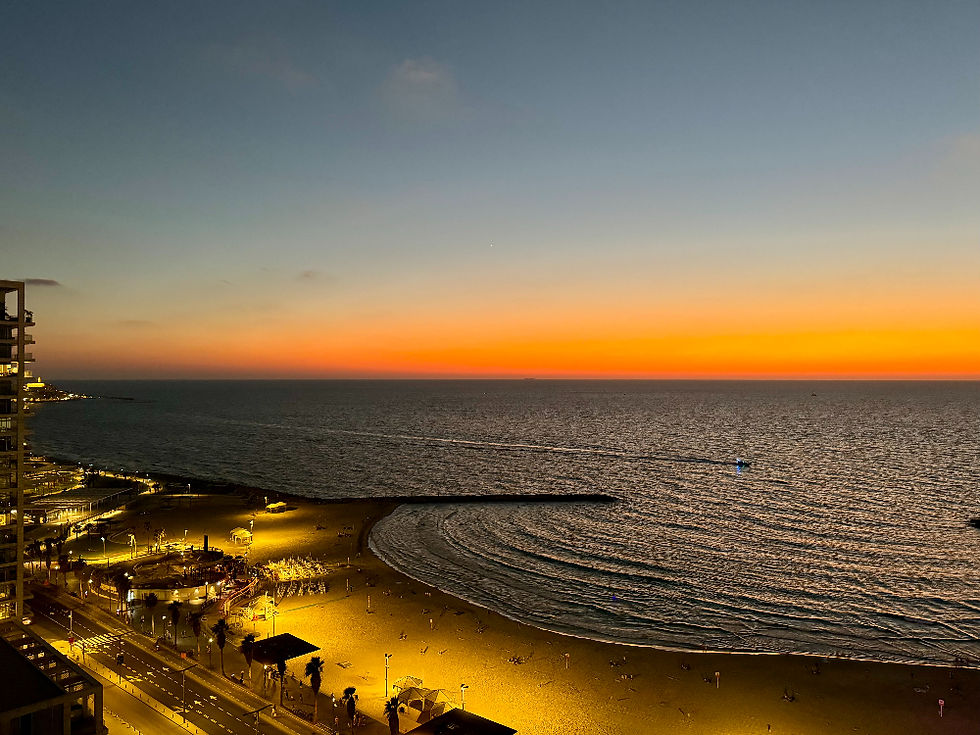
No city without its river, no village without its stream, or at least its brook. I believed this, without ever putting it into words, when I lived in France. When I arrived in Israel more than thirty years ago, the dryness unsettled me. I missed water—not only to quench thirst or to water gardens, but as a familiar, almost reassuring presence. Like a living axis that should run through every human settlement. Here, it was scarce, discreet, subterranean, or distant. Riverbeds lay dry most of the year, and rain followed a strict calendar. No precipitation in summer. Nothing. Not even a few drops.
Israelis have an almost romantic relationship with water. The first rainfall becomes an event. A stream awakened after a storm draws onlookers like a provisional miracle. A simple puddle is enough to spark wonder. As for lakes and rivers, they take on the air of an expedition, a celebration, almost a transgression. One does not merely look at them: one celebrates them.
Without realizing it, I adopted these ways. I too now rejoice at a summer rain—but elsewhere, since here it would be nothing short of a prodigy. I too slow down at the sight of a trickle of water, an improvised basin, a lingering trace of moisture. And then, I swim. As if the body were trying to reconnect with an element so absent from the landscape.
The short story Under the Grey was born of ambivalent feelings: fascination and fear. Currents are dangerous, both in the Mediterranean and in the Sea of Galilee. Flash floods can sweep away a person or a vehicle. And when rain finally comes, it lashes down with furious violence—making it impossible to remain outdoors without being soaked within minutes. Water that soothes, and water that engulfs. Water that promises life, and water that threatens to erase everything. In a country where one learns very early to respect water, to measure it, and to wait for it, imagining it unleashed becomes a way of exploring our most silent fears—and perhaps, too, a strange form of relief.
Under the Grey
Out of habit or optimism—did they truly believe they would be able to return later?—most former residents had locked their apartments. Léa had nevertheless found one with the door wide open and had offered a silent word of thanks to its owners. She was surprised by how easily she had adapted to her new life. Who would have thought it would end this way? Homeless. A vagabond slipping into the intimacy of strangers and looting their supplies. She ate their canned food, wore their clothes, and studied their family photo albums. For drinking water, it was enough to hang a few containers from a window or a balcony. After the anguish of having to leave her own home—a septic tank overflow had rendered it uninhabitable—came a curiosity tinged with apprehension, which in turn gave way to boredom: a profound, numbing boredom she tried to stave off through various stratagems, such as systematically rummaging through cupboards.
This apartment, midway up a skyscraper, was the most luxurious of them all. She spent a few quiet days there in the company of books discovered in the library. When the books were no longer enough, she left her refuge and began climbing the steps of the interminable staircase. On the roof, seized by a terror that had until then spared her, she nearly collapsed. The rain—relentless and heavy—fell without pause. Sky, buildings, and streets merged into the same grayness, like an aquarium closing in on her, suffocating her. She pulled herself together, approached the railing, and trained her binoculars on the ring road. Drawn along the bed of a dried-up river, it had been the first to flood. On the surface, everything seemed calm. The water had swallowed the long line of cars along with their occupants. No sound or movement, apart from wind and rain. Even the birds had left the city. She regretted that news no longer reached her. She would have liked to know what was happening in the Sahara. Perhaps the desert was blooming again… Had regions once green dried out? She imagined a gray North Pole, strewn with the corpses of polar bears and emperor penguins.
Back in the apartment, she changed clothes and equipped herself as best she could: rubber boots, a raincoat, and a waterproof hat. Despite her precautions, she was quickly soaked, but she did not feel the cold. Not yet. One step, then another. The monotony soothed her. She thought of the millions who had fled to the mountains, living under tents and scratching at the ground in search of roots. Did this deluge stem from divine wrath? She herself had made mistakes, of course—more out of indifference or foolishness than a desire to do harm. She had decided not to leave the city. The end of the world suited her own depression and lightened her suffering. Death, which had sometimes tempted her, would come to her soon. Léa now awaited it without impatience.
Water poured into her boots. She kept moving, despite the physical discomfort and a dull anxiety throbbing in her chest. She reached the first waves breaking among the buildings. Almost relieved to be confronted at last with real danger—this immense mass of liquid that would eventually engulf everything—she bent down, caught a few drops in the hollow of her hand, brought them to her mouth, and was surprised to find they tasted the same as ever. She kicked off her boots and walked on to the street bordering the promenade. The water reached her hips, and the current threatened to knock her over. She clung to a post and, mesmerized by the spectacle of the dancing expanse, savored the strange sensation of solid ground beneath her toes.
She caught sight of a movement. Once the initial panic passed, she recognized the curved backs and slanted fins of dolphins. One of them swam toward her. It passed the bus shelter, crossed the street, stopped a few meters away at the edge of the first buildings, and lifted its head out of the water. Its mouth slightly open, it seemed to be smiling. She burst into loud laughter and stepped toward it. Fish and marine mammals had taken their revenge. As for her, she did not care whether she died of hunger, drowned, or crushed by one of these creatures, which seemed far more dangerous up close. More than anything, she wanted to put an end to her solitude.
As this short story is published, my novel A Killer’s Scent has just been released.Writing fiction, in all its forms, remains for me a way to explore what overflows us — and reshapes us, quietly or not.
As this short story is published, my novel A Killer’s Scent is available for pre-order on Amazon, with publication scheduled for early February.
Writing fiction, in all its forms, remains for me a way to explore what overflows us — and reshapes us, quietly or not.
Until next time,
L. M. Rapp


Comments